what is the best way to capture and use carbon dioxide
Banner image: A gas tank with carbon dioxide. (Credit: Haley Petersen)
Academy of Colorado Boulder researchers take developed a new tool that could lead to more than efficient and cheaper technologies for capturing heat-trapping gases from the temper and converting them into beneficial substances, similar fuel or building materials. Such carbon capture technology may be needed at scale in order to limit global alert this century to 2.7 degrees F (1.5 Celsius) above pre-industrial temperatures and fend off catastrophic impacts of global climate change.
The scientists describe their technique in a paper published today in the journal iSCIENCE.
The method predicts how potent the bond will be between carbon dioxide and the molecule that traps it, known as a folder. This electrochemical diagnosis can be easily practical to whatsoever molecule that is chemically inclined to bind with carbon dioxide, allowing researchers to identify suitable molecular candidates with which to capture carbon dioxide from everyday air.
"The Holy Grail, if y'all will, is to attempt to inch toward being able to utilize binders that can grab carbon dioxide from the air [around usa], non simply full-bodied sources," said Oana Luca, co-author of the new written report and assistant professor of chemical science. "Determining the strength of binders allows u.s. to figure out whether the bounden will be strong or weak, and identify candidates for future study for direct carbon capture from dilute sources."
The goal of carbon capture and storage technology is to remove carbon dioxide from the atmosphere and store it safely for hundreds or thousands of years. But while it has been in use in the U.Southward. since the 1970s, it currently captures and stores a mere 0.1% of global carbon emissions annually. To help meet carbon emissions goals laid out by the IPCC, carbon capture and storage would have to speedily increase in scale by 2050.
Current industrial facilities around the globe rely on capturing carbon dioxide from a concentrated source, such equally emissions from power plants. While these methods can bind a lot of carbon dioxide apace and efficiently using large amounts of certain chemical binders, they are too extraordinarily free energy intensive.
This method also is quite expensive at calibration to take carbon dioxide and turn it into something else useful, such as carbonates, an ingredient in cement, or formaldehyde or methanol, which tin can be used as a fuel, according to Luca, fellow-elect of the Renewable and Sustainable Free energy Establish (RASEI).
Using electrochemical methods instead, such equally those detailed in the new CU Boulder-led written report, would costless carbon capture facilities from being tied to full-bodied sources, allowing them to be almost anywhere.
Being able to easily guess the forcefulness of chemical bonds also enables researchers to screen for which binders will be best suited—and offer a cheaper alternative to traditional methods—for capturing and converting carbon into materials or fuel according to Haley Petersen, co-pb author on the study and graduate student in chemical science.
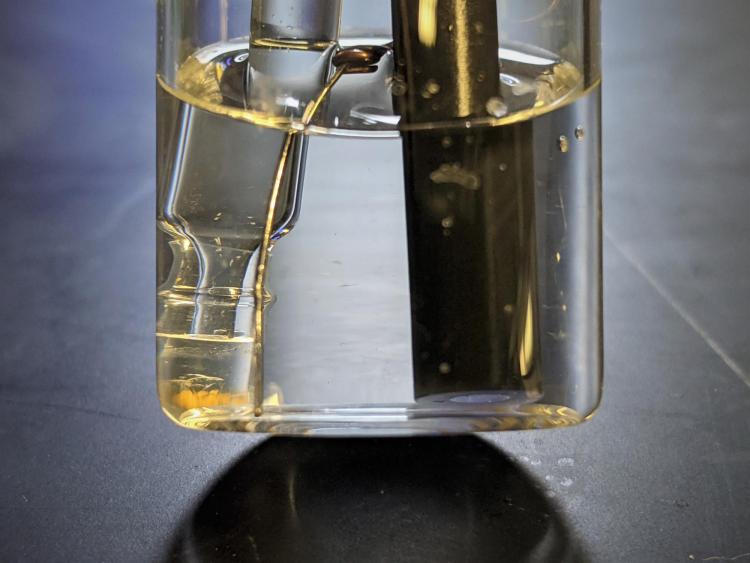
Electrodes being used to actuate molecular bonds. (Credit: Haley Petersen)
Creating chemical bonds
The science of chemistry is based on a few basic facts: One, that molecules are made of atoms, and two, that they are orbited past electrons. When atoms bond with other atoms, they form molecules. And when atoms share electrons with other atoms, they form what is called a covalent bond.
Using electricity, the researchers tin activate these bonds past using an electrode to deliver an electron to a molecule. When they practise that to an imidazolium molecule, like they did in this report, a hydrogen atom is removed, creating a gap in a carbon atom for another molecule to want to bail with it—such as carbon dioxide.
However, carbon dioxide (CO2) is the kind of molecule that doesn't typically similar to create new bonds.
"It's mostly unreactive, and in lodge to react with it, you also have to bend it," said Luca. "So we're in a chemical space that hasn't really been probed before, for CO2 capture."
The method the researchers examines how expert a whole family of carbenes (a specific blazon of molecule, containing a neutral carbon cantlet), that they can electrochemically generate, are at binding CO2.
"Just by looking at very simple molecules—molecules that we can make, molecules that nosotros can modify— nosotros tin can obtain a map of the energetics for electrochemical carbon capture. It is a small bound for at present, but possibly a large leap down the line," said Luca.
Boosted authors on this publication include: Co-atomic number 82 author Abdulaziz Alherz, likewise as Taylor Stinson, Chloe Huntzinger and Charles Musgrave of the University of Colorado Boulder'due south Department of Chemistry, Department of Chemic and Biological Engineering, and Materials Science and Technology Plan.
This cloth is based upon work supported by the National Science Foundation Graduate Research Fellowship nether Grant No. DGE 2040434. Whatever stance, findings, and conclusions or recommendations expressed in this material are those of the authors(s) and do non necessarily reflect the views of the National Science Foundation.
As a global leader in climate, ecology and energy research, the University of Colorado Boulder is partnering with Un Human Rights to co-host the Right Here, Right Now Global Climate Summit in fall 2022.
Learn More than Receive Media Updates
Source: https://www.colorado.edu/today/2022/03/16/new-method-could-lead-cheaper-more-efficient-ways-capture-carbon
0 Response to "what is the best way to capture and use carbon dioxide"
Post a Comment